Posts

Showing posts with the label toxics

Leaded

Image
January's Environmental History  has a review by Leif Fredrickson of Michael Mix's  Leaded: The Poisoning of Idaho’s Silver Valley (OSU Press, 2016). From the review: The poisonous history of the Bunker Hill Company should be as well known to environmental historians as the Battle of Bunker Hill is to historians of the American Revolution. Located in the Silver Valley in northern Idaho, Bunker Hill mining and smelting operations polluted the surrounding area and poisoned residents and workers with lead for a century. In the 1970s, Bunker Hill’s operations wrought “the worst community lead exposure problem in the United States,” according to the Centers for Disease Control and Prevention. The silver lining to the Silver Valley disaster was that it fueled new and stronger national regulations for lead pollution. In Leaded , Mix seeks to unearth the “root causes” of mining and smelter pollution in the Silver Valley. He argues that pollution went unabated for most of the twe...

Ghostworkers and Greens

Image
October's Environmental History  had a review by Erik Loomis of Adam Tompkins's  Ghostworkers and Greens: The Cooperative Campaigns of Farmworkers and Environmentalists for Pesticide Reform (Cornell UP, 2016). Tompkins's book seems to add to a growing body of work on the labor movement as a force behind important developments in environmental regulation . From the review: Because legislation excluded agricultural workers from the New Deal’s labor protections, farmworkers lacked political power, forcing them to seek alliances with middle-class organizations to win their battles and protect themselves from the chemicals used by growers. Environmental organizations needed farmworkers to counter accusations of being anti-worker and to ground their claims in the lived experiences of the most affected populations. The UFW’s 1970 grape contract included provisions that banned growers from using chlorinated hydrocarbons such as DDT and dieldrin. This laid critical groundwork for ...

Love Canal, CERCLA, and deregulation

Image
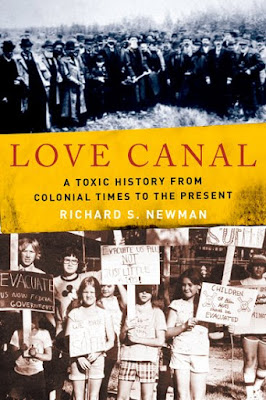
This past summer H-Environment published a Roundtable Review of Richard Newman's Love Canal: A Toxic History from Colonial Times to the Present (OUP, 2016). An excerpt from Stephanie Malin's contribution: While the Superfund Act [CERCLA] resulted from national awareness of Love Canal, and though Newman focuses on the success that legislation represents, we conclude with a troubling denouement. Love Canal is now Black Village Creek, filling up with a new round of working-class residents enticed by homes priced 10 – 20% below market value. Though former residents including Gibbs fought the relocation, they lost this battle. Developers won. The results have been tragic; as Newman recounts, health problems and toxic exposures have reemerged in this ‘remediated’ community, despite the extensive, state-of-the-art environmental engineering schemes used to filter leachate and otherwise remediate the site. Newman’s Love Canal succeeds in highlighting for readers an exceptionally timely...